

Why Memory Is the Missing Layer in Conversational Commerce
.avif)


From Sessions to Relationships: Why Memory Is the Missing Layer in Conversational Commerce
Most “conversational” experiences today are not really conversations. They are short sessions dressed up as chat.
A customer asks a question, gets an answer, and the system forgets what happened. When they come back a day later, they start from scratch. If they switch channels, they start from scratch again. Even if they are a loyal customer, the interaction often feels like the first time you have ever met.
This is not just frustrating. It is expensive.
Every reset loses context. Every repeated question increases drop-off. Every handoff that treats a known customer like a stranger erodes trust and pushes the buyer closer to silence, churn, or a competitor.
And yet, most conversational stacks are still designed this way: optimised for resolving isolated moments, not for building continuity over time.
That is not how people buy, especially not when the purchase involves emotion, identity, or trust. It is also not how good selling works. The best sales associates remember what matters, what has already been discussed, and where someone is in their decision. They do not ask the same questions repeatedly. They do not treat every interaction as a blank slate.
In 2026, the brands that win will be the ones that bring that relationship logic into digital experiences, safely and at scale. The missing layer is not another chatbot. It is memory.
Why memory matters now
Customer expectations have moved faster than most technology stacks.
Personalisation used to be a differentiator. Today, it is table stakes. In its explainer on personalisation, McKinsey notes that personalisation can lift revenue by 5 to 15% and increase marketing ROI by 10 to 30%, and that companies with faster growth rates derive 40% more of their revenue from personalisation than slower-growing peers.
That is the commercial argument. The human argument is even clearer.
Zendesk reports that 74% of customers find it frustrating to have to tell their story over and over to different agents. Salesforce’s State of the Connected Customer research adds another signal: 35% of customers say they would rather work with an AI agent than a human if it meant avoiding repetition (and that figure is higher for business buyers).
Put simply, customers do not hate automation. They hate friction. And nothing creates friction faster than having to restate context every time you interact.
This is why memory is becoming a requirement, not a feature.
Memory is not personalisation
At this point, it is worth making a distinction that is often blurred.
Personalisation is about what you say: the product you recommend, the message you show, the offer you surface.
Memory is about what you don’t have to ask.
A personalised system can still feel exhausting if it forgets what the customer already explained. A memory-enabled system reduces effort. It carries understanding forward so the conversation can progress rather than reset.
This is the shift from sessions to relationships.
The tension: customers want continuity, but they do not trust AI
Here is the catch. Even as customers want fewer repeat questions, they are not automatically comfortable with AI running the experience.
In July 2024, Gartner reported that 64% of customers would prefer that companies did not use AI for customer service, and 53% would consider switching if they found out a company was going to use AI for customer service. Whilst these numbers have since gone down, this shows the crux of the moment we are in.
Customers want the benefits of memory and relevance, but they do not want a black box making decisions with their data, and they do not want to be trapped in a bot loop when something matters.
So, the question becomes: how do you deliver continuity without sacrificing trust?
The answer is not “pick a better model”. The answer is design.
What “memory” should actually mean
When people hear “memory”, they often imagine a system that stores everything: every message, every detail, every preference.
That is not just risky. It is unnecessary.
Useful memory is small, structured, and intentional. In practice, it comes in three layers:
- Conversation continuity
Remembering the last relevant steps so customers can continue without repeating themselves.
- Preference memory
Remembering stable preferences that customers reasonably expect you to remember (size, tone, product or service preferences).
- Journey memory
Understanding where someone is in their decision journey, so the next message fits the moment rather than restarting the funnel.
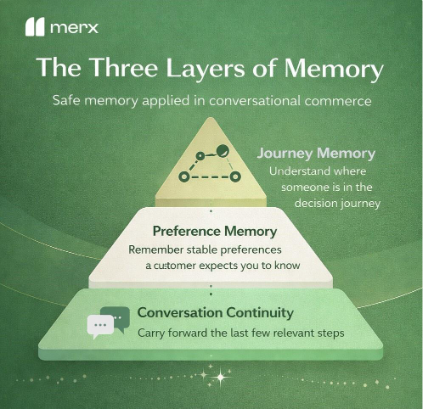
The key point is that memory is about carrying forward the right context. Not hoarding data. Not guessing intent. And not persisting anything that should not be stored
Why “session-based bots” break in real commerce
Most bots fail not because they are unintelligent, but because they are built like support widgets rather than relationship tools.
They do not carry intent forward across time. They do not retain context across days or channels. They do not know what the customer has already clarified. So they ask again. They recommend poorly. They push generic messages. The customer disengages.
This is where the idea of a client-bound agent becomes useful. Not a generic bot that resets every time, but an agent attached to an individual customer context, designed to carry forward understanding safely.
Retailers are moving in this direction because the old model cannot deliver the experience customers now expect.
What safe memory looks like in practice
If memory is going to build trust rather than erode it, it needs guardrails from day one:
1. Minimise what you store
Only persist what clearly improves the experience and what the customer would reasonably expect you to remember.
2. Filter sensitive information by default
Customers will volunteer information you did not ask for. Systems should detect and prevent sensitive data from being persisted.
3. Separate assistance from decision-making
An agent can guide, clarify, and recommend. It should not invent policy, make risky assumptions, or override escalation rules.
4. Make escalation easy
Nothing destroys trust faster than forcing customers to fight a bot to reach a human.
The same principle applies on the brand side. When agents drive outbound communication dynamically, teams worry about losing control. That concern is valid. The solution is not to revert to static blasts, but to introduce the right operating model: QA, approval patterns, feedback loops, and analytics that measure outcomes across the full journey, not just opens and clicks.
Where Merx fits
This is the problem Merx is designed to solve.
Merx treats conversational commerce not as a channel, but as a relationship system. That requires memory, but also restraint.
The platform turns conversations into structured signals that can inform both inbound and outbound journeys, without turning customer context into uncontrolled data sprawl. Memory improves relevance, but risk does not rise with it.
Because Merx is WhatsApp-native, it operates in a space customers already associate with personal communication. Showing up there raises the bar. If you appear in WhatsApp, you are expected to remember what matters, just as a good concierge would.
Across Merx clients, the impact of continuity is consistent. Ads that lead into conversation deliver significantly higher click-through rates (40-60% higher) than ads that lead to sites, and conversational journeys that progress beyond a few messages convert 20% higher than single-message blasts.
The reason those numbers move is not magic. It is continuity. It is relevance. It is memory applied with discipline.
From transactions to relationships
Ecommerce trained customers to browse, click, and check out. The next era will train customers to ask, compare, clarify, and decide in conversation.
In that world, session-based bots are a dead end. Client-bound agents with safe memory are a competitive advantage.
The brands that understand this early will not just improve conversion. They will improve trust, lifetime value, and the feeling customers have when they interact with them.
Memory is not about storing more.
It is about asking less, understanding more, and making every message feel like it belongs.

